How is the construction industry in LATAM adopting technology in 2026?
Reading
6
min
Share it with your network
Buildpeer
October 21, 2026
How is the construction industry in LATAM adopting technology in 2026?
Construction is producing more without increasing its workforce at the same rate.
In Mexico, the production value of construction companies grew 6.9% year-over-year in June 2026, while the number of employed personnel increased by just 0.9%, according to the National Survey of Construction Companies from INEGI.
Hours worked did not grow at the same pace as production either: they increased by 1.0%.
In other words: more work, practically the same team.
This gap helps explain why technology adoption in construction is accelerating: builders, developers, and firms are looking for ways to coordinate their projects.
But the data we have collected at Buildpeer shows something more interesting: companies are quite clear about the problem they want to solve, but few consider one of the factors that will determine if the technology will actually work.
What are they trying to solve with technology?
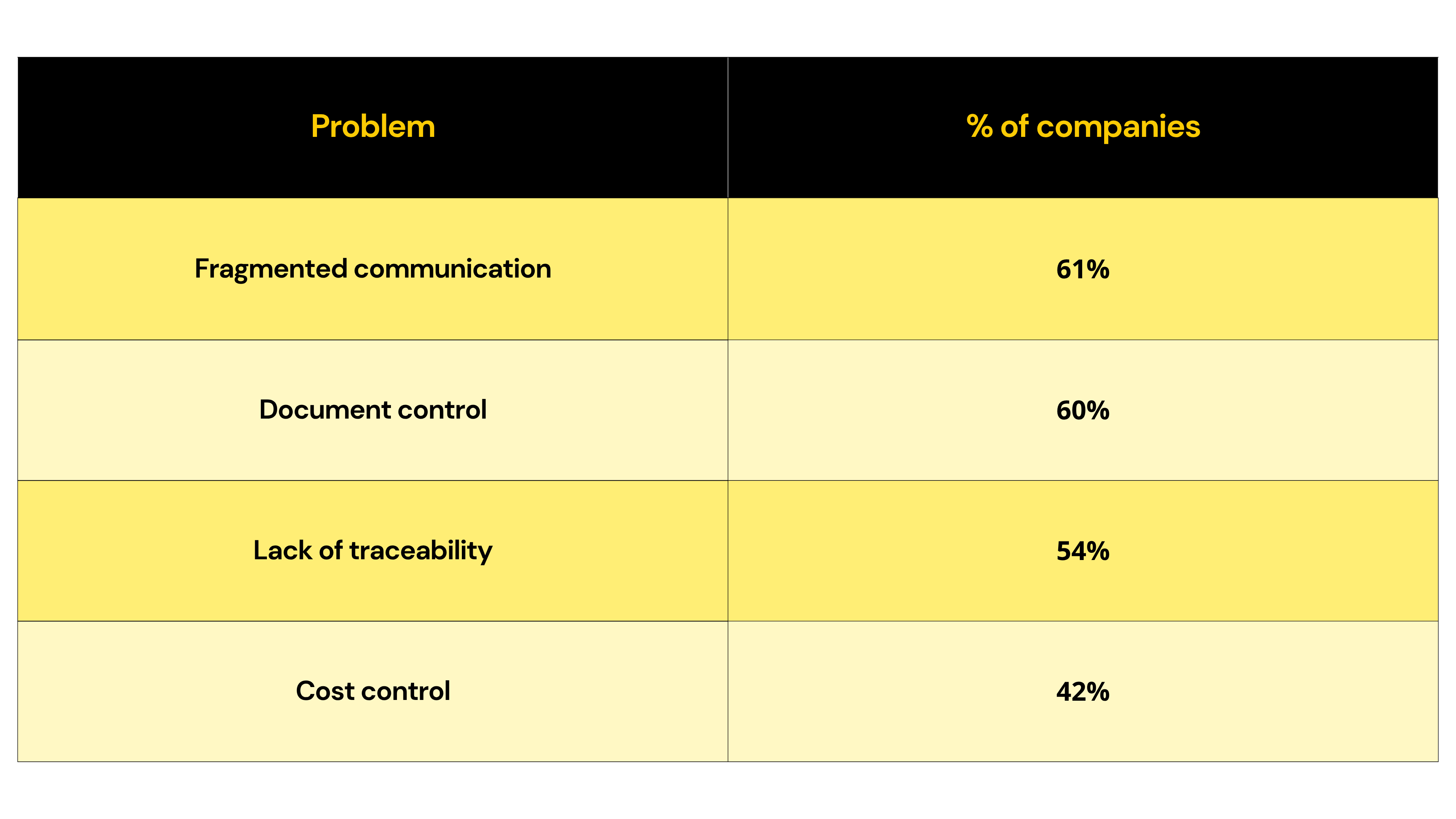
Between April and September 2026, we documented conversations with 224 construction companies that were evaluating how to solve problems within their projects.
This is not a representative survey of the sector. These are companies that were already looking for a solution, so the sample is naturally biased toward teams that identified a problem in their operations.
Even so, the pattern is clear:
The three most frequent problems have something in common: project information is scattered across too many places.
WhatsApp here. Emails there. Photos on phones. Blueprints in folders. Excel reports. And some information is just stuck in the heads of the people executing the project.
Only 2 out of 224 companies mentioned team adoption as one of their challenges.
And that makes sense.
When a company starts looking for technology, they usually already have a visible problem: outdated documents, scattered information, reports that take too long, or a lack of clarity regarding progress.
Adoption isn't a problem yet because they haven't implemented anything.
If, after implementing a platform, all previous processes continue to function exactly the same way, there was likely no real adoption. You just added another tool to the process.
That is why technology starts to generate value when it replaces manual work, not when it simply adds a new screen.
Adoption does not end when the license is purchased
Implementation matters too.
Training the office team is usually the easy part. Getting information captured where it is actually generated—that is, on the construction site—requires ongoing support.
At Buildpeer, implementation begins by understanding how each company works, continues with configuring and training the teams, and then follows up on the actual use of the platform.
The platform allows for reporting from the field, working from the mobile app, attaching photos and notes as evidence, and importing MS Project schedules without having to rebuild them from scratch.
But those features only generate value when they become part of the team's daily workflow.
That is why software is only one part of the implementation. The other is getting people to actually use it.
So, what is changing in 2026?
Technology adoption in construction doesn't seem to be happening simply because companies want to "go digital."
Companies are primarily responding with technology to improve communication, document control, traceability, costs, and progress tracking.
But Buildpeer data shows a blind spot: only 1% of the companies analyzed spontaneously mentioned team adoption as a problem.
And that may be where one of the most important decisions lies when evaluating technology.
Don't just ask yourself:
"What can this platform do?"
But rather:
"What would have to change on the job site tomorrow for my team to actually use it?"
Conclusion
In 2026, the challenge is no longer just finding technology capable of controlling documents, progress, or reports.
It is about ensuring that technology is truly integrated into operations.
Because a platform can have every feature a construction company needs and still fail for a much simpler reason: no one on the job site changed the way they work.
Is technology adoption in construction growing in LATAM?
Activity indicators suggest it indirectly. In Mexico, the production value of construction companies grew 6.9% annually in June 2026, while the number of employed personnel grew by 0.9%, according to the INEGI National Survey of Construction Companies. That gap is part of the pressure driving companies to seek out technology.
What problems are construction companies trying to solve with technology?
Among the 224 companies analyzed, the three most frequently mentioned problems were fragmented communication (61%), document control (60%), and lack of traceability (54%).
Why can an implementation fail even if the software works?
Because using the tool can become an additional task instead of replacing an existing process. If the team continues working as they did before and also has to input data into a platform, adoption becomes much more difficult.
How long does it take to adopt a construction platform?
A realistic minimum support period is one month. It depends less on technical configuration and more on whether the platform replaces an existing process. The key indicator during that first month is how many field personnel are capturing information on the platform.
How do you know if a construction platform has truly been adopted?
The clearest sign is not how many users have an account or how many people received training, but rather what is no longer being done the old way. If evidence is still arriving via WhatsApp and someone is still manually putting together the weekly report, you have likely just added a tool instead of replacing work.