How to solve coordination issues between on-site teams
Reading
7
min
Share it with your network
Buildpeer
August 19, 2026
Most coordination problems on a construction site don't start with a technical error or a lack of team experience. They start when two people are working with different information about the same project.
The site manager thinks a change has already been approved, the supervisor continues executing the previous version of the plan, and management discovers the problem when rework is already inevitable. This situation is much more common than it seems and usually has the same root cause: information is scattered across calls, messages, photos, spreadsheets, and conversations that were never recorded.
When this happens, the problem isn't just communication. It also leads to delays, duplicated tasks, decisions made with incomplete information, and on-site errors that end up impacting the budget and schedule.
The good news is that most of these problems can be prevented if the coordination process is designed so that everyone works with the same information.
In this article, we will look at why these errors occur, which ones are the most frequent, and what actions help improve coordination between teams on-site.
Why does this happen even if the team is communicating?
It is common to think this happens because the team isn't communicating enough. In practice, the opposite usually occurs: people are communicating, but each one is using a different channel.
While a change is shared via WhatsApp, a photo arrives by email, a task is assigned during a call, and an updated plan is stored in a different folder. At the end of the day, every project member has a piece of the information, but no one has the complete picture.
When that happens, each person makes decisions based on what they know, not necessarily on the most recent information. Therefore, improving coordination doesn't mean having more meetings or sending more messages; it means everyone consults the same source of information before acting.
The most common coordination errors on a construction site
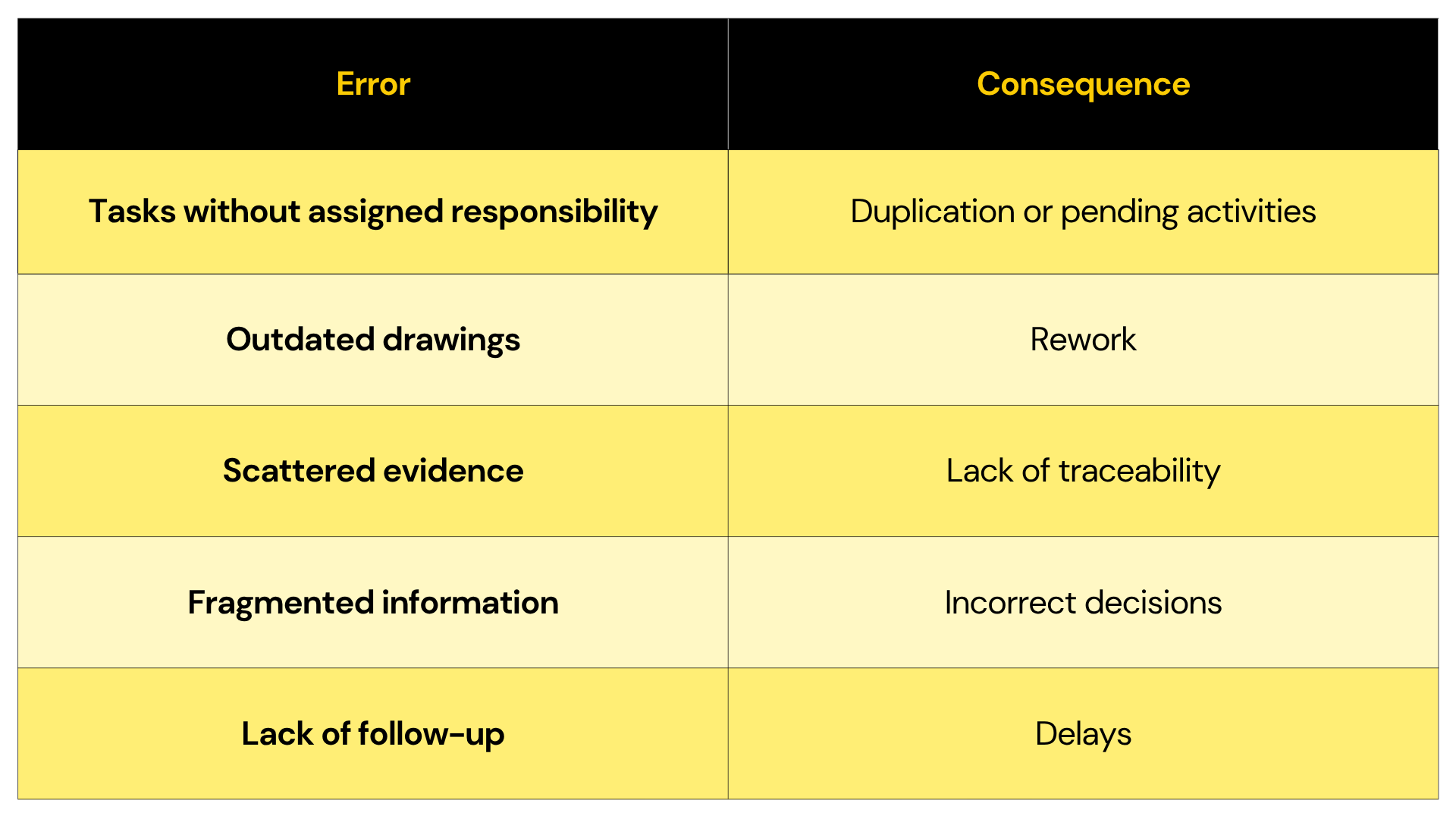
Duplicated tasks or tasks without an owner. Two people perform the same activity, or no one executes it because everyone assumed it was someone else's responsibility. This usually happens when a task is assigned verbally and is never recorded in a searchable place.
Working with outdated plans or documents. Modifications don't reach the person executing the work on-site in time, leading to rework, wasted materials, and delays. We have already written in more detail about this specific problem in our guide on drawing version control.
Incomplete evidence. Photos and records end up scattered across different phones and chats, making it difficult to prove what actually happened when you need it most: during a client dispute or a warranty review.
Decisions made with partial information. Management or the site team acts without the full context. Neither side has incorrect information; they have incomplete information, which is a different but equally expensive problem.
In a table, this is how the relationship between each error and its impact on the project looks:
Transforma la forma en que gestionas tus proyectos de construcción.
Coordination errors trigger a chain reaction: rework, lost productivity, wasted materials, and hours spent reconstructing what happened. The more projects a company manages, the greater the impact of working with scattered information. This is especially noticeable in developers handling multiple projects in parallel and retail expansion teams opening several stores in different cities at the same time: the margin for error doesn't just grow with each new site; it grows exponentially.
There is also a cost that never appears in any report: the trust between the field and the office erodes every time management finds out about something too late, or every time the site manager feels they are reporting into a void with no response. Over time, this leads people to stop reporting with the same level of care.
This is different from budget or schedule errors, which almost always stem from poor planning at the start of a project. We already covered that angle in our guide on how to avoid common construction management mistakes. Here, the problem is different: it’s not that a good plan is missing, it’s that the plan doesn't reach the person who needs it in time to execute it.
A simple example: if management approves a material change on Monday but the site manager doesn't find out until Thursday, by Thursday, the wrong materials have already been purchased or installed. The plan was fine. The problem was the time it took for the information to travel from one person to another.
Coordination shouldn't depend on one person
On many job sites, the site manager or project manager centralizes all the information. While their experience is invaluable, relying on a single person poses a real risk: if that person gets sick, goes on vacation, or simply has a swamped day, coordination grinds to a halt because no one else has the full picture. Information must be available to the entire team so that decisions don't rely solely on one person's memory or availability.
This isn't a problem exclusive to large-scale projects. On a mid-sized project with two or three active fronts, it often hurts even more because there is no dedicated office team to chase down information: someone in the field has to do it on top of their regular work, and every time that person is unavailable, coordination stops with them.
How to prevent this from happening on your job site
You don't need to redesign your entire construction process overnight. Doing these five things helps a lot, and quickly:
1. Assign each task to a person responsible with a deadline and follow-up, visible to the entire team, not just the person who assigned it.
2. Centralize plans, photographs, reports, and incidents in one place, instead of scattering them across WhatsApp, email, and different folders.
3. Document changes as they happen, rather than reconstructing them from memory weeks later.
4. Ensure everyone is working with the current version of documents before executing.
5. Reduce intermediaries so that information reaches decision-makers directly.
What changes when all information is centralized?
When a platform like Buildpeer centralizes tasks, photos, plans, and reports, it reduces the need to constantly ask what happened or who authorized a change, because the answer is available to anyone who needs to check it. Meetings are more productive, decisions are faster, and coordination no longer depends on people's memory. We have already covered in depth what construction management softwareis and what it should solve, if you want to delve into this point before deciding. Explore the complete platform and its modules.
Signs that your project has a coordination problem
Two people report different progress when asked separately.
Tasks are assigned via WhatsApp or calls, and no one checks them again afterward.
Multiple versions of the same plan are circulating at the same time.
Reports arrive hours or days after the actual progress has been made.
When a key person is absent, no one else knows the actual status of the project.
If two or more of these signs sound familiar, it is likely not an issue of your team working poorly, but rather that the process you use to coordinate has a gap that is worth closing before it leads to a major delay.
Conclusion
Coordination on-site improves when everyone works with the same information. Assigning clear responsibilities, documenting changes, and centralizing information with a platform like Buildpeer helps reduce errors before they turn into delays.
If your company still relies on calls, messages, and spreadsheets to coordinate construction, the next step is likely not to work harder, but to improve how you share information. If you want practical construction management ideas like this every week, follow us on the Buildpeer Mural. And if your project is already at the point where this feels familiar, schedule a Buildpeer demo and compare it directly with how you coordinate your team today.
Preguntas Frecuentes
Are coordination problems the team's fault?
Not necessarily. They are usually process failures: information doesn't have a single place to live, so each person works with whichever version they happened to see.
Do more meetings solve the problem?
They help with alignment, but they don't replace a single source of truth. If information continues to travel via WhatsApp or word of mouth between meetings, the problem returns in a matter of days.
Does this only happen on large projects?
No. It also happens on medium-sized projects with multiple work fronts, and it often hits them harder because there is no office team dedicated to chasing down information.
How do you detect a coordination problem?
When there are different versions of the same information, or tasks get lost across different channels without anyone confirming them. If this happens once, it might just be a bad day. If it repeats every week, it is a process problem.
How quickly is the change noticed if the process is corrected?
You'll usually notice it within the first few weeks, with less rework and less time wasted clarifying different versions of the same thing.




.png)






.svg)
.png)


